Is Dr. Brownstein an Unwelcome Hero? It’s Your Call.

hydrogen peroxide structure
Food Grade Hydrogen Peroxide is a natural compound found in tiny trace amounts through-out our environment – and once again it is turning up as the healer it has been known to be for over a century – in our most current health crisis. We are not surprised.

Recently we heard from one of the people we like to follow – Ms. Lynn McTaggart, about a holistic doctor out of Michigan who was having great results along with other members of a team of doctors using nutrition and immune support to successfully treat COVID symptoms.

Well, we were not the least bit surprised to find that our old stand-by for all things good and healthy was a part of the mix.  Yep. Food grade hydrogen peroxide and even intravenous hydrogen peroxide were used in different ways as part of the protocol for those patients who needed addition support beyond oral doses of Vitamins A, C, D and iodine.

In fact, they even talked about using a nebulizer with saline, a few microliters of food grade hydrogen peroxide, magnesium sulfate and Lugol’s iodine to do hourly treatments for thos patients whose symptoms did not respond directly to the other protocols first.

And they were having some amazing results!
Hmm! Maybe all those people talking about nebulizing with hydrogen peroxide are not crazy after all…

Looks like we won’t be hearing about this on the NIGHTLY NEWS any time soon, so we thought we should give you a chance to find out about it yourself, since no one seems likely to be shouting it off the rooftops either.

You can read Ms. McTaggarts entire piece here.

And we suggest you do, because you will definitely want to know exactly how these doctors did what they did and how successful it was. In fact you might want to know all the institutions they are affiliated with so you can make a note of who you want to talk to if you have personal health concerns yourself.

And, you’ll also want to know how the US government responded to this great news. Yes, yes we think you will. And we are sorry to say we do not think you are not going to like it one bit.

But we also have to say we are not at all surprised because we have understood for some time now that we live in a captured land. Controlled by monied interests which wish to keep us as their willing or unwilling consumers of their ‘solutions’ for as long as possible before we finally break free.

Free to eat clean healthy food. Free to use clean healthy remedies which do no harm and only heal. Free to live as we see fit and treat our bodies and our lives as we see fit. Free to avoid toxic synthetic pharmaceuticals, toxic chemical laden foods and free to thrive as healthy awake and alert humans finding new solutions for the vast array of problems these monied interests have created in our world.

We live in a time full of opportunity to heal the earth through regenerative agriculture, heal our bodies through healthy eating and restoring our internal ecology, and turn the tide on the sixth great extinction. Or, we can be swept into oblivion by big pharma, industrial agriculture which is dumping billions of pounds of antibiotics and countless other poisons into our soils, air and water, and go out faster than the dinosaurs taking a vast, complex and divine contingent of living creatures with us. The choice is ours. And the need to make the right choices has never been clearer.

Posted in Articles, Food Grade H2O2 Tips, News | Tagged , , | Leave a comment

California Drought: Hydrogen Peroxide and UV Light Critical Players in California’s Expanding Water Recycling Plants

The new waste water recycling process uses H2O2 and UV light for the final stage of disinfection rather than chlorination which is shown in the illustration as the old waste water treatment method.

New Waste Water Recycling Methods Implemented in the Santa Clara Waste Water Recycling Plant in 2014 Image Courtesty of San Jose Mercury News.

The California drought is not a new story for anyone paying attention, but its increased severity, as well as recent steps by public officials to actively curb water use by State residents has made it more visible to the rest of the nation, and the world.

California Drought Means Limited Water Supply

While there are heated battles raging over the use of California’s dwindling water supplies for such things as hydraulic fracking and by corporate users like Nestle’, who purportedly bottle up to 80 million gallons of California’s precious water every year just from one aquafer, the push to expand and improve recycling of waste water in California is a less well known story.

California has some of the largest and most extensive water recycling facilities in the world, with a new 8 million gallon capacity plant going into operation in Santa Clara county only last year. While the water is not yet taken directly into the residential water supply, the potential of such water use in the future is real. To date, two municipalities in Texas are the only sites where recycled water is fed directly to homes.

H2O2 and New Waste Water Treatment Technologies

These plants use a special series of steps to take waste water and deliver clean potable water at the outflow end of their process. A practice, it would seem, which should really be used anywhere waste water is processed, rather than the old fashioned method of simply porting it off to the closest open water way or ocean.

The three steps used to clean the water are micro filtration, reverse osmosis filtering and finally ultra violet light and hydrogen peroxide disinfection.

The use of ultra violet light and either hydrogen peroxide or an ozone treatment has become popular for use in swimming pool and hot tub filtration as people have sought to move away from chlorinated pools and spas, and there are now several commercially available pool and spa disinfection systems using these methods.

Rural Drinking Water Systems

Variants of the waste water disinfaction system have also been used as a final disinfection stage in spring fed water systems in rural homes and communities where there was danger of water borne illness and disease.

Essentially, the hydrogen peroxide and UV light work together to accomplish disinfection in a series of interactions. The hydrogen peroxide is injected into the waste water stream causing oxidation, and the oxidized wastewater stream is passed through channels passing through or under UV lights which destroy the VOCs in the wastewater stream. VOCs are either destroyed in the oxidation UV phase or with additional carbon absorption before the water is discharged.

Cleaning Up Toxic Superfund Sites

These systems can also be used for the cleanup of toxic waste ‘superfund’ sites and the list of contaminants able to be removed is very impressive, and goes well beyond simple residential waster water treatment requiresments to include such toxic contaminants as benzine, vinyl chloride, MBTE, and even polychlorinated biphenyls (PCBs).

So, while it is certainly far from ‘sexy’ to think of drinnking recycled waste water; the public acceptance of the idea has risen from near zero to over 50 percent in the State of California in the last few years as drought conditions have worsened. And, with hydrogen peroxide as part of the path to cleaner water, it may soon be possible for waste water treatment plants in California to be using recycled water for municipal water supply uses. At present, recycled waste water in California is used primarily for industrial and other non residential uses.

Even without returning the water to the residential water table at present, this water plays a critical part is supplying clean fresh water needs in California.

Sources:

California Takes Serious Look at ‘Toilet to Tap’ Tech

Hydrogen Peroxide and UV Treatment 

California drought: San Jose’s new high-tech water purification plant to expand recycled water use


Posted in News | Tagged , , | Leave a comment

Could Hydrogen Peroxide Really Help End World Hunger?

A haredi youth stands next to piles of potatoes in Jerusalem (Photo credit: Matanya Tausig/Flash90)  Read more: Could an Israeli-created innovation end world hunger? | The Times of Israel http://www.timesofisrael.com/could-an-israeli-created-innovation-end-world-hunger/#ixzz3IoTJ1TJp Follow us: @timesofisrael on Twitter | timesofisrael on Facebook

A haredi youth stands next to piles of potatoes in Jerusalem (Photo credit: Matanya Tausig/Flash90)
Read more: Could an Israeli-created innovation end world hunger? | The Times of Israel http://www.timesofisrael.com/could-an-israeli-created-innovation-end-world-hunger/#ixzz3IoTJ1TJp
Follow us: @timesofisrael on Twitter | timesofisrael on Facebook

This newest hydrogen peroxide breakthrough actually goes back a ways: the people who are responsible for the breakthrough have been working on it a long time. But their expanding success in many different applications is very exciting and it just gets better and better.

Imagine a way to prevent food from spoiling, even without refrigeration, for days and even weeks longer than ever before possible. Imagine the impact on the hungry people of the world if the foods they needed could actually reach them still fresh, still nutritious and ready for them to eat.

After all, the largest populations of starving people are also those with the least access to proper food transportation and refrigeration. We think you’ll agree this is Big News!

It is hard to imagine the extent of the impact of such a breakthrough.

As stated in the Time of Israel article

“Produce of all kinds is “lost” to spoilage and disease, due mostly to transportation, storage, and other logistics issues. As a result, hundreds of millions of people still go hungry – but they don’t have to, thanks to an invention by Israel’s Pimi Agro. By applying a formula based on hydrogen peroxide — “with a few key additions,” said Nimrod Ben-Yehuda, CTO and co-founder of Pimi – fruits and vegetables remain fresh and viable for up to 10 weeks…” (emphasis added)

Think about that! Ten weeks is a very long time! This would allow all kinds of produce to be transported vast distances without spoilage. And that could mean the difference between starvation and viable healthy food to eat for millions of people.

Read the full article at the Times of Israel.

Don’t let anyone tell you we don’t live in exciting times. This is just another example of what innovative people willing to take on big problems can do! Congratulations to Pimi Agro on your outstanding work!

Posted in News | Leave a comment

Hydrogen Peroxide Proven Once Again the Safest, Most Effective Way to ‘Deconstruct’ Dangerous Toxic Chemicals

A gas mask can protect us from toxic fumes or gases but how do we clean it?

Gas masks can protect us from toxic chemicals or chemical weapons, but what do we do with them when their filters are full of toxic gases?

Hydrogen Peroxide Safely Eliminates Toxic Chemicals (Chemical Weapons) from Activated Carbon Filtering Materials.

We’ve been saying for years that h2o2 is capable of cleaning up just about anything, and solving just about any household cleaning problem, that is for sure. But now, a new research project out of Israel is proving us right in a way we hadn’t anticipated.

While we hope none of our readers ever has to deal with a toxin- laden gas mask, it turns out hydrogen peroxide can solve that problem too.

Researchers have found that hydrogen peroxide safely removes chemical weapons gases  sarin, VX and sulfur mustard trapped in the activated carbon filters of protective gas masks, breaking them down into harmless compounds. This provides a simple, inexpensive and readily available solution for decontamination of the activated carbon which is used to protect against such chemical weapons.  Hydrogen peroxide was found to effectively break down over 95% of the tested substances.

The implications of this research are considerable. You may recall a story we covered after hurricane Katrina, where scientists proved it was possible to remove toxins and contaminants from flood waters with a treatment using hydrogen peroxide and a copper catalyst. While this did not result in potable water, it did remove the dangerous toxins which could cause disease, infection and death by contact with the water.

So, while you could not drink the resulting water, it would not kill everything it touched; and could then presumably be properly filtered to produce clean drinking water.

Gas mask filters trap the toxins and then what? The filters can be removed from the masks, but burning them releases the toxins in the air. Washing them puts the toxins in the water and does not adequately remove them from the filters, either.

What to do? Soak them in a solution of hydrogen Peroxide. The job can be accomplished in one hour by using a 20% solution. The toxins will be oxidized into harmless components.

So there it is: hydrogen peroxide has been proven to safely deconstruct toxic chemical weapons.  It is beginning to make a lot more sense to be using hydrogen peroxide as a safe cleaning agent that can effectively eliminate risks of toxic exposure as well as removing pathogens.

Activated charcoal is an excellent adsorbant of toxins used all over the world for the capture of everything from nuclear radiation in large power plants to toxic waste in smoke stack emissions, gas masks, air and water filters and many other applications.  But cleaning those filtering devices is another logistical problem to be considered.  Simply removing the filtering material to another location, such as a storage dump or a landfill does not solve the problem.

Hydrogen peroxide has proven once again that it is the molecule of choice when it comes to clean up and contamination remediation. Now used in vaporous form for everything from hospital disinfection to laboratory clean up and potential anthrax and other chemical weapons attacks or spills, hydrogen peroxide has demonstrated its superior efficacy as a detoxifying agent in nearly every commercial, industrial and scienetific field.  Surely it is time for the general public to know about and take advantage of hydrogen peroxide.

Cheap, safe and easy to use, it is hands down, the cleaning agent of choice.

Now, I don’t know about you, but this is terrifically good news to me – because it demonstrates once again something I’ve surmised for decades: hydrogen peroxide is the ultimate fast, easy, safe and effective solution for cleaning even toxins from our homes. If it can break down these toxic gases, it’s no surprise it was proven effective at eliminating black mold and e-coli from contaminated surfaces.

So, the next time someone tells you that the only safe way to eliminate a mold, bacteria or other contaminant in your home is with chlorine bleach, remind them that while chlorine can kill lots of things, it is also toxic. It does not break down to simple water like hydrogen peroxide and in fact, while the ‘studies’ always show that it breaks down to ‘simple salts’ all these studies were done in clean laboratories.

In the natural environment of our homes or the world in genera, chlorine mixes with simple organisms in the environment and  produces ‘organochlorines’. While few people have heard of ‘organo-chlorines’ there is one that most people do know by name: Dioxin.

Don’t be persuaded away from using your trusted, safe and effective hydrogen peroxide by ignorance in the general population and marketplace.

Do remember that for most household cleaning jobs a simple 3% solution is all you need. For complete disinfection of food preparation surfaces you can alternate sprays of 3% hydrogen peroxide and white vinegar and achieve a 99.9% disinfection rate.

Always wear gloves and eye protection when handling concentrations higher than 3%.  All concentrations of hydrogen peroxide will dilute with water, so whenever you need to stop its oxidizing action, flushing with water will return hydrogen peroxide to a simple water (H2O) solution.


References:

De-gassing gas masks with hydrogen peroxide

Decontamination of Adsorbed Chemical Warfare Agents on Activated Carbon Using Hydrogen Peroxide Solutions

Posted in News | Tagged , , , , , , , , , | Leave a comment

South Carolina Gardener Gets Ginormous Results Growing Tomatoes with Hydrogen Peroxide

Beautiful FruitsWe’ve used hydrogen peroxide in the garden and on house plants for years, with great results.

Using it when sprouting seeds speeds up the sprouting process, too.

But this South Carolina gardener  has done something most folks have never even dreamed of. He grows tomatoes that are 12 feet tall!  You read that right. Twelve feet tall! That’s some mighty big growth for a tomato plant, wouldn’t you agree?

How does he do it? Well, I actually had to get on the telephone to speak with him about it, because I wanted to know what he was doing to get these results.

Not just ‘a general idea’ like ‘he uses hydrogen peroxide’ but exactly HOW he does it, right? No vague sort of maybe kind of or guess work for me, I wanted the stratight scoop. Here’s what I learned.

There ‘s a method to his madness.

First, he grows plants he gets from seedlings to about 12 inches tall, then he re-pots them and plants them in at about 6 inches deep, so half the plant is in the soil, and trims them back.

Giant TomatoesNext, he grows those plants up until they are 18 inches tall or so, and plants them into the garden the same way- planting half the plant in the soil so they are now about 9 inches tall in the garden. He does two other things when he plants them out into the garden:

1. He fills the bottom of the planting  hole with his special hydrogen peroxide solution.
2. He trims back all the major limbs on the plant so there’s no leggy growth.

He then sprays the plants a couple times a week with his H2O2 solution. He says he also likes to let the plants get at least one good ‘wilt’ in the first month – so their roots will work to go deeper. Otherwise, he gives them plenty of water.

The solution he uses? 1 part 3% hydrogen peroxide to 8 parts water.

Pretty simple! But what amazing results!

And in case you’re wondering if these tomatoes are all bush and no fruit, just take a look at the second photo of those gorgeous tomatoes. And don’t forget to trim those sucker leaves every week or so, yup, you still have to do that too. 🙂

Posted in Garden Uses | 1 Comment

101 Home Uses of Hydrogen Peroxide

For most of us, hydrogen peroxide is that brown bottle we picked up at the local drugstore eons ago, and stuck in the back of the medicine cabinet.

Let’s keep this simple. First, the three major areas of household and consumer uses of hydrogen peroxide are:

Hydrogen Peroxide Home Uses

Hydrogen Peroxide in the Garden

Hydrogen Peroxide for Pools and Spas

Home uses of hydrogen peroxide literally run the gamut from the kitchen, laundry, bath, and all through the house, right out into the garden.

Replacing toxic abrasive and environmentally persistent chemicals as they go; these 2 H’s and 2 O’s join together to create a cleaner clean and a safe, healthy environment in and around the home.

In recent decades hydrogen peroxide has replaced chlorine in major industry applications from paper mills to fabric production. This replacement has been a direct result of the discovery of the dioxin class of chemicals which result from industrial uses of chlorine and are extremely toxic. Isn’t it time we did the same thing at home?

Perhaps, hydrogen peroxide’s diverse and varied uses from water purification to rocket fuel have led to the seemingly endless misunderstandings about this simple chemical compound. These diverse uses have led to the production of many different classes of hydrogen peroxide. These classes of hydrogen peroxide are determined by their ability to maintain stable high concentrations for specific purposes. Many of these industrial purposes have led to the use of toxic-to-human stabilizing chemicals in their production.

Food grade hydrogen peroxide has the highest standard for non-toxicity to humans. This does not mean that Food Grade hydrogen peroxide is designed or designated as a food or a food product or for human consumption; it does mean that the stabilizers in it are not the toxic stabilizers used in industrial and pharmaceutical grades of hydrogen peroxide.

Food grade hydrogen peroxide is prepared for use in the food preparation and packaging industry. It is regulated for its ability to safely sanitize food preparation and packaging facilities. At its 35% solution strength it will kill bacteria, pathogens, fungi and other microbial organisms within 20 seconds of contact. Yet it breaks down into oxygen and water upon release of its oxidizing properties.

While certainly there is no useful application for rocket fuel grades of hydrogen peroxide outside of very strict and controlled environments; there are hundreds and thousands of applications for its less concentrated varieties.   Because industrial uses do not require a non-toxic or “food safe” stabilizer in most cases, they are unsuitable for use in and around our homes and kitchens.

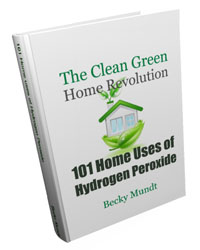
If you are truly serious about hydrogen peroxide uses be sure to check out our book “101 Home Uses of Hydrogen Peroxide

Posted in Articles | 1 Comment

H2O2 and Baking Soda: The Ultimate Insulated Mug and Thermos Restoring Combination

Insulated coffee mugs are great, no question; but after a while, even with regular washing, they can look pretty dingy and even affect the taste of your favorite brew.

What to do?  You can’t put them in the dishwasher, and even if you could, it probably would not accomplish what you want. Because what you want is a like-new fresh and clean cup with no coffee stains, that has no taste or odor of coffee.  A mean trick if you’ve been using it for any length of time…

There is one solution that is simple, fast and works like a charm.

Place two or three tablespoons full of baking soda in the cup; fill it about three quarters full with hot tap water, add either two tablespoons of 35% food grade hydrogen peroxide or, if using 3%, just top off the cup until full with the 3% H2O2, and let it sit overnight. To get the lid fresh and clean just set it sideways in the top of the full cup, so the opening you drink out of is submerged in the liquid as well.*

*NOTE: If using 35% dilution do NOT screw the screw top onto the cup or thermos as the pressure can build up dangerously causing the lid to ‘explode’ off!

There is no more powerful and effective whitening and de-odorizing combination than baking soda and peroxide, as the pictures here make clear.  In the morning, just rinse the cup out with running water, no scrubbing, no work, no muss no fuss.

You’ll know just how great this little remedy for a clean coffee cup is when you taste the next cup you pour into that cup – WOW! Fresh coffee that tastes like fresh coffee!

This is also a great tip for anyone who has an insulated cup or thermos that has been used for coffee for a long time.  Especially if you decide to switch to tea or want to use the thermos for soup or some other hot beverage – and don’t want it all to taste like old coffee. Just use this same procedure and you have a thermos or insulated cup that will deliver a nice cup of earl gray or whatever else you like to drink and it will not taste like you are drinking tea or soup made with coffee.

Thermos cleaned with H2O2 and Baking Soda

Posted in Home Uses | Leave a comment

Speed up Spring Planting: Using H2O2 to Boost and Speed Up Seed Germination

sprout seedlings faster with food grade hydrogen peroxideGetting plants into the ground at just the right time can be tricky business. Never mind the weather choosing to co-operate or not, the seedlings have to be the right size to head out into the garden on time; and if they’re not, you just have to wait…

One way to make sure your seedlings are in tip top shape and ready to go right on schedule is to boost your germination rate and the speed of germination by giving seeds a head start as you go.

Most seeds (excepting lettuce) require no light to germinate. But did you know they also require no fertilizers, plant food or other nutrients? Seeds have everything they need packed right into them to germinate. The trigger that gets them started is moisture. Once they get wet, the signal is sent and the seed gets to work getting ready to send out a sprout.

What most people don’t know is that seeds actually do something pretty amazing when they start this process: they breathe!  They respirate in the moist soil and use up the nutrients stored in their outer layer, as well as splitting open that layer, so they can spout.  That’s why if you sow your seed in a soil mix that is too wet they won’t germinate: they can’t breathe and they will rot. Same thing happens if you get super rainy weather outside after planting – the seeds can’t breathe and they die.

So here’s a trick for giving your seeds an extra boost to get them off to a healthy start, especially those indoor seeds that need to get growing in a tight time-frame in order to get into the garden on time…

1. Make up a solution of .05 to 1% hydrogen peroxide in a spray bottle. [Dilution: Using 3% H2O2: add 2 parts filtered or distilled water for each part 3% H2O2. Using 35% FoodGradeH2O2 add 1 to 2 TBS to 1 quart (32 ounces) of filtered or distilled water.] Note: when possible do not use chlorinated water, as it inhibits seed growth; if necessary, fill a pitcher with tap water and let stand for 24 hours to allow the chlorine to dissipate; otherwise use filtered or distilled water. (Rain water works fine too!)

2. Saturate a paper towel with the spray and carefully fold the seeds into the center of the towel, keeping them in a single layer if possible.

3. Place the little packet you’ve made on a clean plate or in a clean bowl overnight, or, if you wish, until you see the tiny sprouts start to emerge.

4. Keep the towel moist with the H2O2 solution, but not soaking wet. And DO NOT let it dry out!

5. Plant your seeds, in pots, flats, or right out in the garden, according to the seed and the timing of your sprouting.

This method will cut at least a week off most larger seeds (peas, corn, squash, cucumber, melons, sunflowers etc.) and can cut as much as two weeks off germination time for those finicky folk like celery, peppers, eggplants and spring flowers.

If you’re not sure you’ll have time or patience to keep them in the towel and moist until they sprout just plant them after at least 24 hours of this treatment, they’ll still come up faster. Why? Because the H2O2 oxygenates the seeds and gives them a kick start.

So, next time you’re fretting that you’re late getting those vegetable starts into flats, don’t fret. Just follow these instructions and you’ll get caught up for planting time in a jiffy.

Oh – and one more tip:  once you start them in the flats, you can continue to spray them with a mist of 1% peroxide as they grow – they’ll grow faster and stronger too.

And don’t forget, once they sprout they will absolutely need to be kept moist, and will be ready for a little compost tea or other nutrient rich meal – they have enough stored energy to sprout all by themselves, but once they sprout, they will be hungry!

If you’re not sure how tender the seed is, just use the lesser dilution and experiment. A 1% or less solution seems to be safe for just about any seed, but test it out for yourself and determine the dilution rate that works best for you.  We’ve used .05 and 1% with equal success.

Posted in Articles, Garden Uses | Leave a comment

Hydrogen Peroxide Structure: Oxygen and Water

Hydrogen peroxide is a naturally occuring compound formed within the cell structures of plants and animals, in the earth’s atmosphere and in the waters that cover the earth.

Hydrogen Peroxide Structure:

Formed in the upper atmosphere when water and ozone combine to produce oxygen and hydrogen peroxide; its true chemical role in the mechanism of climate and rainfall is far from being clearly understood even today.

Hydrogen (H) and Oxygen (O) – building blocks of the natural world.

Hydrogen Peroxide: H2O2

Hydrogen peroxide was discovered by French Chemist Louis-Jacques Thenard in 1818. Coining the phrase “eau oxygenee” to describe its properties, Thenard believed it to be an oxygenated form of oxygen.

Oxidation:

An oxidizing agent is a chemical compound that readily transfers oxygen atoms. Hydrogen peroxide is a common oxidizing agent. It breaks down readily in water, becoming water and oxygen as the oxidizing agent releases its extra oxygen atom. This action of releasing the extra oxygen atom bound in the hydrogen peroxide is what is defined as oxidation.

Without water to dilute the effect, highly concentrated formulas of hydrogen peroxide are volatile, unstable, caustic and downright powerful.

It is this powerful action that makes hydrogen peroxide an exceptional rocket and space ship propellant. The simple power of oxidation when concentrated becomes capable of creating enough energy to lift spaceships off of launch pads and into outer space.

Simple yet effective, the actions of hydrogen peroxide in household concentrations (3 to 9 percent by volume in a distilled water solution) are also oxidative, and therefore, solutions of dry hydrogen peroxide once mixed with water become reactive upon contact with the water, and will lose their potency after approximately five hours. Liquid solutions will maintain their potency so long as they are stored properly. Both dry and liquid forms of hydrogen peroxide offer a powerful, effective, non-invasive and environmentally clean household cleaner, disinfectant, odor eliminator and all around useful chemical compound.

Hydrogen peroxide is produced naturally within plant biomass and plays diverse and pivotal roles within the plant kingdom. It is present in trace amounts in rain, water, and snow. It is also present in higher concentrations in such natural healing springs as Lourdes, Fatima and St. Anne’s.

As a commercial chemical it was first used in the restoration of famous paintings to remove sulphur build up without damage to the paint or canvas beneath. It has been long favored in textiles pulping, fabric production and bleaching for its ability to whiten with minimal damage to fiber structures, and has been used as an environmentally sustainable replacement for chlorine bleaching in many paper and pulp operations around the world.

Hydrogen peroxide is a healthy, environmentally clean and sound approach to clean bleaching of paper pulp, water purification, hydroponic and water garden waters, aquaculture and other industries and is used extensively in the disinfection of food preparation equipment, asceptic packaging of food products and disinfection of hospitals, medical laboratories, and sites contaminated by such dangerous compounds as anthrax, viruses and toxic bacteria.

Posted in Articles | Tagged , , , , | 2 Comments

Spring Cleaning Non Toxic Method

non-toxic spring cleaning

Non toxic spring cleaning.

It’s been 21 years since Susan Sumner’s work with non-chlorine disinfecting methods for food science at the Virginia Tech was written up by Judy Stouffer and published by  Science News, August 8, 1998.

But for all that, the world seems mostly not to have heard about it.

Here’s a brief recap:

Susan Sumner, a food scientist at Virginia Polytechnic Institute and State University, worked out the recipe for a safe, non-toxic sanitizing solution for the kitchen, food surfaces and produce.

. All you need is one spray bottle of three percent hydrogen peroxide, and another of plain white or apple cider vinegar.

That’s it. Two clean spray bottles – one of each liquid.

To clean vegetables or fruit, just spray them all over with first one and then the other, it doesn’t matter what order you go in, and then run them under cold water to rinse.

Side note: the major source of bacteria like e-Coli is fresh produce, not meats, so it’s a great idea to wash your produce this way, because it will kill 99.9% of all bacteria present.

Ms Sumner’s tests also proved that this 2 sprayer combination works as a perfect sanitizing method for all kitchen surfaces that come into contact with food, from cutting boards to counter tops sinks, and utensils. Use the same method of spraying one and then the other, then wipe clean with a clean cloth.

We’ve used this system in our house now for most of the two decades since Ms. Sumner’s science work was published, and it is cheap, fast and easy to do. Best of all, it’s completely harmless to you, your family and the environment. It won’t harm septic systems, surfaces, or utensils, either.

One more tip: in recent years there’s been a lot of talk about dangerous bacteria and mold in sponges and the advice is to throw them out (in part because they never fully dry). Bleach won’t clean them. But no one ever did this study with them, as far as we know.

We soak our sponges in 1/2 bucket of hot water and 3 scoops of sodium percarbonate (dry hydrogen peroxide,*) for 4 hours or overnight, whatever is easiest at the time. Then rinse and spin in the washing machine and they’re good to go again. Eventually they do fall apart, but this gets a longer life out of them. It works exceptionally well with the thin European style sponge cloths, too.

*Dry hydrogen peroxide, or sodium percarbonate is often sold as ‘color safe bleach’ or ‘oxygen cleaner’. You may remember Oxy Clean – but that brand has added other ingredients which are not named on the packaging. All you need is sodium percarbonate.

Posted in Articles, Home Uses | Tagged , , , , , | Leave a comment

Hydrogen Peroxide in the News – Expanding Decontamination Repertoire for H2O2

Biological Hazard Symbol

Bilogical Hazard Symbol

It was only a matter of time.  After all, the track record for decontamination with hydrogen peroxide is extensive, and so far exceeds any other process, that it’s only logical that it would be the method of choice for decontamination of Ebola sites.

 High Concentration Hydrogen Peroxide ‘Fog’

The method employed by the Texas company handling the cleanup of the apartments where patients with active Ebola symptoms were present, employs a high concentration fog of hydrogen peroxide. The fog is introduced into the space after a strong static electric charge is introduced. This allows the oxidizing molecules to ‘stick’ to all of the surfaces being decontaminated more effectively.  Before the peroxide is introduced to the contaminated area, it is impregnated with a dye visible under black-light.  This makes it possible to monitor the results visually.

High concentration hydrogen peroxide fogs are also used to decontaminate medical laboratories and hospital rooms. Foams and fogs of high concentrations of peroxide have also been used in the decontamination of areas suspected of anthrax contamination.

 Expanding Role of Hydrogen Peroxide in Decontanimation

New applications for decontamination employing hydrogen peroxide continue to be perfected around the globe, treating everything from chemical spills to infectious disease and contaminated filtering materials. Peroxide’s ability to break down the contaminants into harmless by-products of the originally toxic components makes it an especially effective decontaminant agent as it eliminates the need to destroy all the contaminated materials and buildings. For more info visit https://foodgradeh2o2.com.

Source:

http://www.kvue.com/story/news/health/2014/10/14/texas-company-owner-explains-ebola-decontamination/17267515/


Posted in News | Tagged | Leave a comment

New Study Finds Vitamin C Helps Heal Cancer – H2O2 Has Interesting Roll

Studies examine vitamin C in cancer therapyNice to see this new article in the LA Times, and to see that finally after all these years, the medical profession is starting to take vitamin C seriously again… But sad to see that it will most likely go nowhere because as even the medical professionals themselves point out, there is no money to be made in proving vitamin C heals anything – “because you cannot patent it.”

Incredible to see it so blatently stated that no cure that might actually work to heal people suffering from cancer will get anywhere unless it can be turned into a mega-moneymaker for the drug companies.  What a sorry state of affairs we are all in.

An interesting side note of the story is the role of hydrogen peroxide:

“In the new experiments, researchers examined the effects of vitamin C, also known as ascorbate, on a variety of cancer cells in the lab and in ovarian cancer cells in mice. When high concentrations entered the space between cells, it formed hydrogen peroxide.

That chemical went to work on cancerous cells in several ways: It damaged their DNA, it stressed their metabolism and inhibited their growth, said study senior author Qi Chen, a biochemist at the University of Kansas”.

Perhaps some day the world of health care will really be driven by the desire and goal to make people well, rather than the drive for personal wealth by a select few. We can only hope. Meantime, keep following the stories of those who are experimenting outside the walls of the ‘halls of medicine’ which seem, at least for now, to be run by greed rather than the oath to ‘do no harm’.

http://www.latimes.com/science/la-sci-vitamin-c-cancer-20140206,0,6444357.story#axzz2sZhThKYd


Posted in Articles, News | Leave a comment